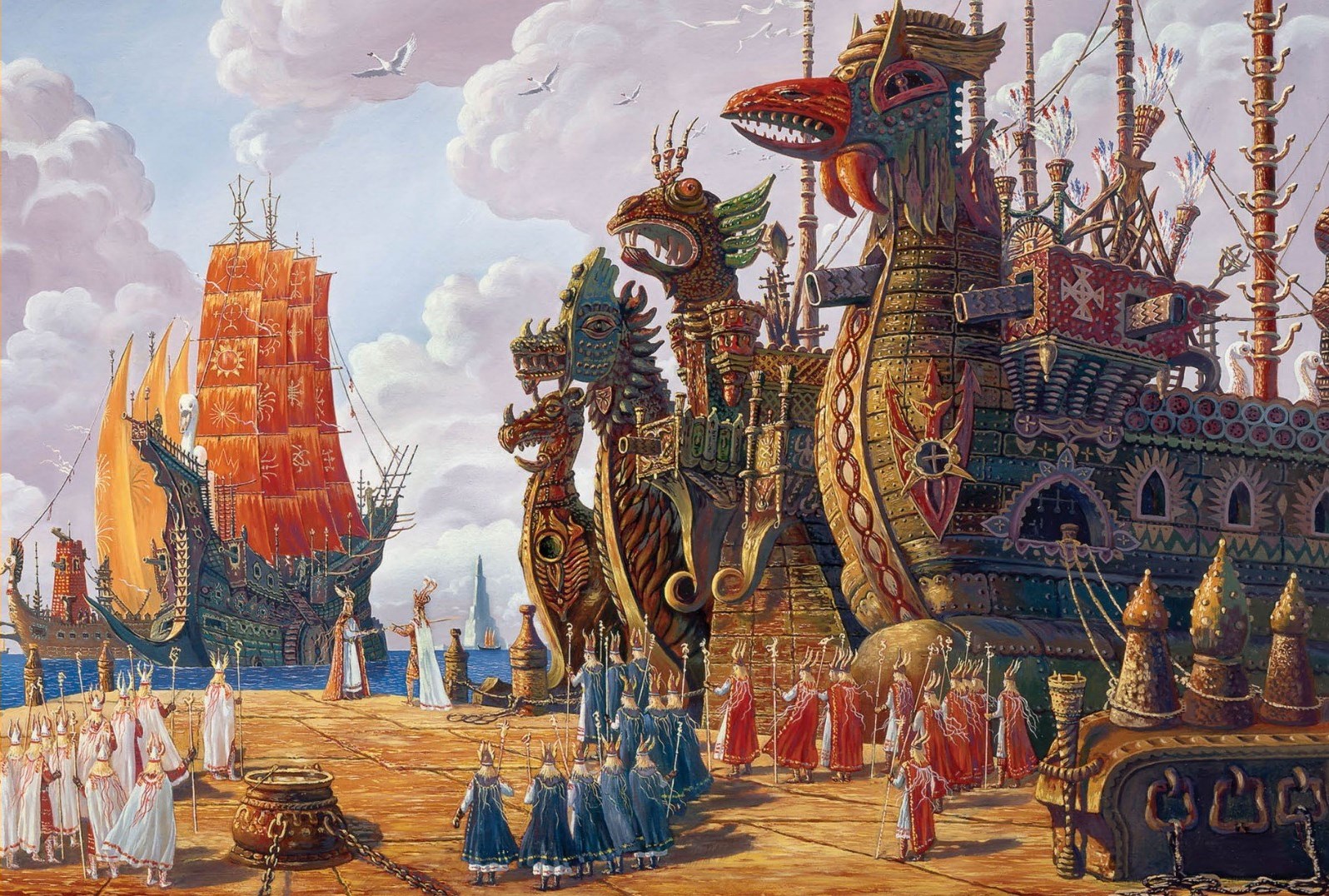
If we try to visualize Númenor during the last days, what
would the technological level of the country be like? We do know that Sauron
taught them a lot of things.
The HOME books have descriptions of Númenor being an
industrial nation with steam-punk technology such as metal ships and even
missiles:
"The teaching of Sauron has led to the invention of
ships of metal that traverse the seas without sails, but which are hideous in
the eyes of those who have not abandoned or forgotten Tol Eressea; to the
building of grim fortresses and unlovely towers; and to missiles that pass with
a noise like thunder to strike their targets many miles away."
(History of Middle-earth 5)
“Our ships go now without the wind, and many are made of
metal that sheareth rocks, and they sink not in calm or storm; but they are no
longer fair to look upon. But our shields are impenetrable, our swords cannot
be withstood, our darts are like thunder and pass over leagues unerring.”
(Again, History of Middle-earth 5)
It seems that the steam-powered ships of metal were dropped
in the Silmarillion version (which is the "final version", for all
intents and purposes), where the ships are obviously wooden and use sails:
“..., and they [the fleets of the Númenóreans] were like an
archipelago of a thousand isles; their masts were as a forest upon the
mountains, and their sails like a brooding cloud; ... Then Ar-Pharazôn hardened
his heart, and he went aboard his mighty ship, Alcarondas, Castle of the Sea.
Many-oared it was and many-masted, golden and sable; ...
(Silmarillion)
In the end, it seems like Tolkien dropped the idea of
Númenor being a steam-powered high-tech state, and instead made it a pre-modern
society. But it must have been the most advanced pre-industrial realm possible,
since the author tells us that the natives of Middle-earth often mistook them
for gods, and we know they created some pretty awe-inspiring architectural
works (Isengard, Minas Tirith, Argonath, etc) in Middle-Earth even after their
downfall.
If looking only by Silmarillion, Akallabeth, we are told
that during Sauron's stay at Numenor they “devised engines" whatever that
means, evidently some Numenoreans were practicing alchemy (shown in Faramir's
words “withered men compounding strong elixirs") and alchemy leads
sometimes to discoveries in the chemistry, their engineering knowledge too
would be impressive, even such construction feats as giant bridge of Osgiliath
(with Dome of Stars), Kings House on arches on Anduin river, Isengard and
Hornburg, Argonath, Minas Ithil and Minas Anor (Tirith), massive bridge of
Tharbad, made in times of Gondor indicated that Numenor was full of such
massive buildings. If only smaller part of their knowledge was saved from the
cataclysm it would lead to interesting speculations, what they were capable of,
maybe they built in Numenor great archologies, cities where nature and
technology were in unity due to elvish sensibilities. Elves taught them much
and cultivated gardens in the central lands of the island. Armenelos must have
been truly magnificent. In metallurgy and weapon making they were superior to
any other human nation but not as great as elven or dwarven work. Here there
are also those spells “for the bane of Mordor", we know that by some art
the daggers were not rusting after thousands of years and remained incredibly
sharp able to pierce trolls hide with ease (trolls skin is so hard that average
sword can bounce off it, it requires a lot of strength to harm a troll with
usual weapons, Barrow Downs daggers were made in Arnor but knowledge definitely
came from Numenor), also medicine was advanced, they were able to make
invigorating draughts and food stuff with the qualities of lembas and miruvor
(by the way this vitality drink was also made by orcs but with less potency), extremely
useful for armies. Only small fracture of old lore survived to Third Age in
Houses of Healing.
How big could have been their ships, probably massive as
everything else, one of the ships of Aldarion was called popularly Wooden Whale
so its size definitely was impressive. Not much of other things is known, it is
my own speculation but maybe they also knew physics (actually optics) Saruman
said that white light can be broken I can imagine that such basic knowledge was
known to advanced Numenor civilization (elves probably too know it, and could
teach the Numenoreans during their visits) elves knew how to make glass, so
maybe they made lenses (telescopes maybe as we have a reference to astronomy or
astrology, ”in high cold towers asked questions of the stars"). Who knows,
maybe Feanor's crystals that showed things from far away were not only Palantir
but also more mundane optic devices and this knowledge could have come to
Numenor.
About the elves in Numenor it's written in Unfinished Tales,
the elves of Tol Eressea came often with visit and brought much of the fauna
and flora to the island and we know how elves are great in agriculture and
gardening :) Gildor Inglorion company had fruits larger and tastier than
anything that could be found in the best tended gardens. The description of
Numenor in Unfinished Tales tells something about the environment of the island
and its resources. Elves brought many species like: kirinki (small scarlet
birds), seven kinds of Fragrant Trees (I don't remember all their names, one
that comes to mind is Oiolare which bough was taken as a sign of good fortune
on the prows of ships).
Also there is a reference in Akallabeth (and Lotr) that
Numenoreans were able to embalm the corpses of their dead. So human anatomy in
medical science would be well known (not to mention the required use of
chemistry and thanatology). Probably Numenoreans also had some skill in mining,
smelting and refining various ores if indeed they had mithril there on the
island (in this one case they would come pretty close to dwarven abilities if
in the purpose of processing mithril is required some higher technology, but I
assume there was rather small amount of it, the island was stated to be rather
poor in precious metals, before they started to get profits from colonial
empire).
Their buildings are always large in scale:
“But Sauron caused to be built upon a hill in the midst of
the city of Numenoreans, Armenelos the Golden, a mighty temple; and it was in
the form of a circle at the base, and there the walls were fifty feet in
thickness, and the width of the base was five hundred feet across the center,
and the walls rose from the ground five hundred feet, and they were crowned
with a mighty dome. And the dome was roofed all with silver, and rose
glittering in the sun, so that the light of it could be seen from afar off; but
soon the light was darkened, and the silver became black. For there was an
altar of fire in the midst of the temple, and in the topmost of the dome there
was a lover, whence there issued a great smoke."
Well this particular building was built by the will of
Sauron and was not typical for Armenelos architecture but judging by the height
of later monumental structures: Minas Tirith (about 1000 ft) they sure know how
to show off with construction feats. King's Palace would be much greater than
this temple (and the city existed for thousands of years before Sauron even got
there). What style the building would have? Hard to guess, but certainly there
were made from stone delivered from stone-quarries near city of Ondosto (it
must have been quite thriving industry, constantly providing building
materials).
Those engines mentioned in my previous post made me wonder,
some machinery was definitely involved so the bits of text about metal ships
going without wind might be considered as part of the technology after all
(those ships would also perished in the cataclysm along with knowledge of their
making so nobody could make another one, in fact Faithful would probably
despise the very idea for it would mean using Sauron's knowledge, Akallabeth
mentions that ships of Great Armament had sails and many oars but it doesn't
exclude the possibility that such ships were build).
As for magic I think that there indeed was present in
Numenorean lives, they themselves were granted with special gifts which made
this nation very elf-like if you know what I mean. Their craft is one thing but
such abilities like Denethor possessed thanks to the blood of Numenor “he can
perceive if he bends his will thither much of what is passing in the minds of
men" and there is told that in Numenor “and it is said in old tales that
where there was great love between men and women and their favourite steeds
they could be summoned at need by thought alone." The enchanted blades too
seem to confirm that these people possessed certain powers (like elves and
dwarves).
Possibly a hint about Numenorean engineering in book two,
where we get this part about Minas Morgul:
"Paler indeed than the moon ailing in some slow eclipse
was the light of it now, wavering and blowing like a noisome exhalation of
decay, a corpse-light, and a light that illuminated nothing. In the walls and
tower windows showed, like countless black holes looking inward into emptiness;
but the topmost course of the tower revolved slowly, first one way and then
another, as a huge ghostly head leering into the night."
I imagine that the Numenoreans who built Minas Ithil used
this type of pre-modern engineering, with hydraulics and massive gears, to make
the top of the tower rotate around.
The line in The Lost Road maybe hints that Sauron improved
their normal weapons, as well as inventing new ones: "But our shields are
impenetrable, our swords cannot be withstood, our darts are like thunder and
pass over leagues unerring."
These “darts like thunder" might have been a reference
to firearms (nothing too fancy, artillery cannons, not personal guns, or it's
just super boosted catapult :) Numenoreans earlier were known for long range
weapons (bows of hollow steel, by the way, man how strong they must have been
to draw one) so it would be perverted form of their previous style of fighting.
About material knowledge from Sauron, metallurgy for one such as him should
have no secrets, new alloys, better quality steel who knows. By the way I tried
to find out what metals besides the precious ones (and imaginary) were known to
inhabitants of Arda, not much, so let's list them: iron (obviously, copper,
bronze and steel alloys by extension, tin and lead. In metalwork Dark Lord
could probably surpass the best elven and dwarven smiths (the reference to them
mining coal made me wonder whether they possessed technology to properly refine
steel using coal in production instead of a standard charcoal, and that
technology appeared about 1780)
Sauron's “help" would be much admired, like the one
thing with “defying lightning" so they would call him god and I bet he
would use some of his skill in manufacturing showing that his creations are
better. Besides other more flashy examples of his innate power he would present
his solutions for doing things “better and faster" as Ted Sandyman thought
about this large, fully mechanized mill which turned out to be something more
sinister, poisoning the river (after being fooled by Saruman, Sandyman allowed
to build new mill destroying the old one). Dominating others through display of
power and higher knowledge was always Sauron's forte. From his association with
fire Sauron could probably bring temperatures impossible to achieve in normal
furnaces and have more pure metal from ore, not to mention possible sorcery
involved giving new unknown qualities, evil enchantments on first look useful.
From the information we have about battering ram Grond we know it had “spells
of ruin" on it.