Friday, August 24, 2012

Numenore – Technology Maxed - Non-Canon(sic)


Numenor on the eve of the sailing of Ar-Pharazon the Golden to challenge Sauron?


And Ar-Pharazon instead sails and lands in Iberia with his force of around 250,000 men, who all stand over 6', indeed, the term "man high" represents 6'4", and Elendil the Tall, who lived then, was said to be over 7'6". Not to mention, all are armed and armoured with some of the greatest steel weapons, including 6'6" long bows made of hollow steel.


That was before the Great Armament.


It would happen about 100 years earlier, when Ar-Pharazon assembled a force so great that Sauron's minions feared the Dunedain more than they feared their own master.


So the Dunedain are not actually yet on the search for eternal life by seizing the Deathless Lands.


But also, I think that the population of Numenore is great enough that they would never need to breed with the Lesser Men, it is in the millions, possibly in the 10's of millions?!


I have seen in Tolkien's books some matter that seems to suggest that in the later part of Ar-Pharazon's reign Numenor had steam powered ships.


Other possible technology in Tolkien's world is:-

Internal combustion engines. Some of the machines that attacked Gondolin were clearly not flesh-and-blood dragons.

Powered aircraft (some exiled Numenoreans after the fall)

Numenorean rocket missiles ("Our darts are like thunder and fly over leagues unerringly", as a Numenorean writes in one of Tolkien's books says).


If all this and its necessary infrastructure landed in Bronze Age Europe and America, it might quickly develop into a modern technological system.


The Numenoreans began to get gadget-happy (and more militaristic) as they became dissatisfied with the Valar's gifts and began to desire immortality, which led to them being corrupted by Sauron.


Their more advanced tech is also associated with Sauron...in "Unfinished Tales," one of the Faithful comments that Sauron taught them how to build vessels that propel themselves.

Numenor - DBM Version 4.8


Numenor - DBM Version 4.8 (14 May 2006; superseding v4.7 of 22 November 2002) Numenor

Warm. Ag 4. WW, Rv, H(S), H(G), Wd, O, V, E, RGo, Rd, BUA.
1
C-in-C - Reg Sp (S) @ 27 or Reg Bd (O) @ 27
1-2
Sub-generals - as above
6-12
Guards - All Reg Sp (S) @ 7 or all Reg Bd (O) @ 7
1-2
Scouts - Reg LH (F) @ 4
8-32
Spearmen - Reg Sp (O) @ 5
10-24
Cohorts - all Reg Bw (O) @ 5 or all Reg Bw (S) @ 7
0-1
Light stone-throwers - Reg Art (I)
0-8
Auxiliaries - Irr LH (F) @ 4
0-6
Auxiliaries - Irr Ax (O) @ 3
0-8
Ships - Reg Gal (S) @ 4 or Irr Shp (S) @ 4 (Sp, Bd, Bw)
0-6
Transports - Irr Shp (I) @ 2 (Bg, Reg LH)
Only after 2A1700:
Eldar allies - List: Noldor
Only before 2A3319:
Easterling vassal allies - List: Easterlings
Southron vassal allies - List: Haradrim (may not include regulars)
Only after 2A3319:
0-1
Upgrade C-in-C to Reg Bd (S) @ 29
Hillmen allies: - List: Dunlendings 

Numenor was a large island far from the coasts of Middle-earth, inhabited by the descendents of the Men that had served the Noldor in the first age. This lists covers Numenorean armies from when the first permanent havens were set up in Endor around the year 1200 of the second age, until the start of the third age, including the Kingdoms in Exile, Gondor and Arnor, after the fall of Numenor proper in 2A3319. Numenoreans did not fight on horseback, leaving the job of scouting to bow-armed light horse generally of foreign origin. Guards wore black and silver. Archers were organized into cohorts and had steel bows. It is uncertain what secondary arms were carried. Numenorean ships were large, with towers and many masts. They might be equipped with auxiliary oars. Noldor allies cannot be used with other allies. Allied contingents drawn from this list need not contain any guards.
DBA: 1 x 2LH, 1 x 2Lh or 3Ax or 4Sp, 1 x 4Bd or 4Sp, 4 x 4Sp, 4 x 4Bw, 1 x 4Bw or 4Sp
HotT: 1 x Hero or 2 x Blades or 2 x Spears, 1 x Riders, 4 x Spears, 3 x Shooters, 2 x Shooters or Spears 

Enemies: Easterlings, Mordor, Haradrim, Dunlending


Army List Notes: Numenor
Numenor was a very large island peopled by the men, the Edain, allied to the Elves of Beleriand at start of 2A. The Numenoreans were slow in returning to Middle-Earth, at first content with their own island, but gradually taking lands for their own, until they became the most powerful empire Middle-Earth had ever seen. The island was drowned in the great cataclysm of 2A3319, but its culture survived in the two successor states of Arnor and Gondor. These are covered by their own lists in 3A, but use this list in 2A post 3319. 

Aggression is rated 4, as Numenor itself was never invaded, while the Nmenoreans conquered many other nations. Gondor and Arnor were likewise aggresive in overthrowing Sauron. The terrain list and climate reflects the island of Numenor itself, a land with a favourable climate (UT, p165ff) and resources. A road is compulsory, as the state was very well-organised, with many roads, for the most part unpaved however (UT, p169). 

Numenoreans fought almost exclusively on foot (UT, p278), the only exceptions being mounted scouts. They were well-organised, disciplined, and trained to a high standard. They formed up in shield-walls when on the defensive (UT, p272), and used longer weapons than the short Orcish spear (UT, p273), and are hence graded as Reg Sp (O). Guards units existed (UT, p271) - I assume that these would be equally capable with sword or spear. That they could form up in wedge formations (UT, p273) would certainly point to a Bd classification being permissible. In any case, Numenoreans used axes as weapons (UT, p170). The option for a Bd (S) C-in-C is to cover Elendil wielding Narsil (Sil, p354). 

As well as these close-fighting troops, archers were also employed. They were organised into cohorts and shot dense volleys, and are accordingly graded as Reg Bw (UT, p170). These were longbowmen using steel bows (UT, p273), and can accordingly be classified as Bw (S). 

Engines of war are mentioned (Sil, p330) which I have assumed to be similar to those of their Gondorian descendents (RotK, p158). 

Auxiliary light horse-archers were employed (UT, p278), hence the LH (F) listed, and the Ax (O) represent those tribesmen of the forests and hills that they at first befriended (Sil, p316). 

Numenoreans were excellent mariners, and used naval forces extensively, for instance in the defence of the Grey Havens (eg UT, p239) assisting the Noldor against Sauron. Such was the size of the Numenorean fleet on this occasion that it could scarcely find harbourage (hence the large number of naval elements allowed, and the rating of the Noldor as allies, rather than the Numenoreans being allied to the Noldor). 

Before Numenor fell, it had laid vast parts of Middle-Earth under vassalage (Sil, p319); such peoples were not very advanced, and so cannot contain regular troops. The Hillmen of the Ered Nimrais swore allegiance to Gondor; as they in fact refused to take the field against Sauron they are counted as allies (UT, p430). 

The banner of Elendil was black, with a white tree, surrounded by seven stars, surmounted by a gold and silver crown (RotK, p145).

Thursday, August 2, 2012

Numenorean Army and Armour


What we can surmise…
When we return to the Arthadan army, the following prerequisites for the introduction of large archer-contingents are met:
• The Dúnadan realm often has to fight against the numerical odds. The need for an effective, massed, ranged weapon that weakens the enemy before the melee begins is therefore great.
• Large contingents of its enemies, such as Orcs and tribal Easterlings, tend to be not overly disciplined and only lightly armored on the battlefield (at least compared to 14th and 15th century European knights).
• It has sufficient numbers of skilled bowmen to form a powerful archery corps.

This last requisite is extrapolated from Tolkien’s statements about the Númenóreans. In Unfinished Tales, we read that “… shooting with bows on foot and on horseback was a chief sport and pastime of the Númenóreans. In later days…it was the bows of the Númenóreans that were most greatly feared (UT.170).” Considering the overall conservatism among the Dúnedain, it seems very likely that the Faithful preserved their old military traditions in Middle-earth, as long as these did not contradict their philosophy. Even if we allow for a decline in skill and lore and the slow disappearance of the powerful steel bows, the tradition of skillful archery should have been active even among the indigenous and mixed people of Arthedain who are heavily influenced by the culture of their lords.

During the Second Age, the Númenórean armies made extensive use of massive archer contingents: “…in those days the great cohorts of the King’s Archers used bows made of hollow steel… (ibid).” Even at the beginning of the Third Age, the archers of the Dúnedain were still feared and highly skilled, as we learn in the essay about the disaster at the Gladden Fields: “They [the Orcs]… kept at a distance out of the range of the dreaded steel-bows of Númenor… (UT.273).” Considering all these facts, it seems very likely that the widespread tradition of archery was preserved in Arthedain (the Dúnadan realm in Eriador with the purest Númenórean tradition).

In one respect, however, Dúnadan knights differed significantly from their medieval European counterparts: they were not inclined to true cavalry warfare:
The Númenóreans in their own land possessed horses, which they esteemed. But they did not use them in war…. In war they were used only by couriers, and by bodies of light-armed archers (often not of Númenórean race). (UT.278)
Therefore the typical Arthadan knight might use his horse(s) for transportation to the battlefield, but whenever possible would fight on foot.


Citadel Guards and Fountain Court Guard [film version]
Founded as an order of elite guards answerable only to the king of the southern realm. Only the best warriors that Gondor has to offer are picked to join the Guard, to be clad in their ancient armour and to carry blades of Westernesse and Númenorean steel composite bows, heavy with both age and honour. The guardsmen themselves are the very image of the first Men of Núménor to settle the shores of Middle-earth, tall and stern, proud and steady in battle. They protect the lords of Minas Anor and the sacred places of the Mound of Mindolluin with a resolute devotion. In the absence of a king, the guards take their orders from the Steward of Minas Anor, sworn to obey his every command until death claims them.

Steel Bows
The Númenórean steel bow should be an almost devastating weapon. I suggest using it sparsely because of its power and the loss of lore among the Dúnedain in Endor. In my opinion, it should possess ca. 150% the strength (damage) and range of a normal longbow. If you use Hârnmaster, treat a steel bow as if it were two categories higher than usual (e.g., a steel longbow is treated as a strongbow, a heavy steel longbow as a greatbow, etc.), but only one category higher in Strength requirements (e.g., a steel longbow uses the strength requirements of a heavy longbow).

Even in the case of the fabulously gifted Noldor and Naugrim, there are absolutely no indications in Tolkien’s writings that they ever possessed something similar to the elaborate plate armor of the 14th and 15th century.

Where Tolkien wants to describe advanced technology, he usually does not describe anything significantly more modern than the legends he draws from, from Beowulf to the Edda and the Chanson de Roland, but moves within the time frame set by these and their contemporary sources. Instead, he uses the levels within that time frame, and occasionally uses more advanced materials for items that were not, historically, used. For example, Tolkien sometimes describes blades as damascened steel to accentuate their superiority, while their real historical counterpart was of inferior material. Similarly, in The Hobbit, he describes how the Dwarves expanded the concept of mail armour to hose, another development which occurred much later than the introduction of coats of mail.

Thus, I believe that while Tolkien did not plant people 1:1 from our world to Middleearth, he mixed even the very Anglo-Saxonlike Rohirrim with Ostrogoths and consequentially put them on horseback. He used material from within the framework of his sources, and additionally described weapons and armour from a time frame that spans from the mythical time of Beowulf in the 5th or 6th century to the Bayeux tapestry and the first crusade in the late 11th or 12th century. This is the end of the historical scope of his sources though; barring any plate-equipped knights in a true-to- Tolkien scenario in Middle-earth. --- by Oliver Haussth.
 
The exception but a very unique singular one:
Now the traffic of the Dwarves down from the Blue Mountains followed two roads across East Beleriand, and the northern way, going towards the Fords of Aros, passed nigh to Nan Elmoth; and there Eöl would meet the Naugrim and hold converse with them. And as their friendship grew he would at times go and dwell as guest in the deep mansions of Nogrod or Belegost There he learned much of metalwork, and came to great skill therein; and he devised a metal as hard as the steel of the Dwarves, but so malleable that he could make it thin and supple; and yet it remained resistant to all blades and darts. He named it galvorn, for it was black and shining like jet, and he was clad in it whenever he went abroad. - Chapter 16 Of Maeglin - Silmarillion

#

Eöl loved the night and the stars, and among all the Firstborn of his time he was the one closest in friendship with Dwarves, who instructed him in smithcraft and who were in turn later taught by him in techniques of his own. His greatest creation as master smith was the so-called galvorn, a black metal harder than steel but light in weight and supple, whose most special component was iron from a meteorite. He forged two swords with this metal, Anglachel and Anguirel, and they were powerful weapons indeed. But when he had used all his stock of meteorite iron, he became obsessed with finding a way to make an alloy of earth-delved metals that could resemble the properties of his prized galvorn. He spent long years trying more and more complicated processes, and visiting the Dwarves to exchange knowledge and find a way to achieve his goal. Finally, he discovered the way to create an alloy better than steel for forging weapons and armor, which he called morglân, but this was still insignificant when compared with the mighty galvorn. However, he found it useful because he could produce it in much greater quantity than galvorn, despite the process needing several years to be completed. He shared his secret only with his younger brother, Dúhir.-addition by José Enrique Vacas de la Rosa - MERP

Wednesday, July 18, 2012

The Building of the Tower of Orthanc


There was but one choice for the Master Builder of Angrenost, and that was Curugond of Lamedon. He had overseen the building of Minas Anor nearly thirty years earlier, and though old, was the most cunning builder that the Dúnedain had produced since the days of Númenor. Great friendship he had with the Dwarves of Khazad-dûm, who shared their arts with him, but Curugond gleaned even more from their teachings than they guessed, and as his knowledge grew, so did his pride. Curugond’s thought was fixed on the Barad-dûr, which had been the greatest tower of its age. Why, he thought, should Gondor not build a fortress of such stature, an answer to the darkness of the previous age?


When he travelled to the vale to survey it, he discovered Ciryanar’s vision of a tower within a ring was not mere fancy. Only half-buried beneath the soil deposited by the Isen, was a rough, natural ring of black stone, the lip of some ancient volcano laid low by time and nature. Curugond’s designs were greater than they ought to have been, a mark of pride. He made plans to carve four great slabs of black stone from the centre of the ring, forming the tower’s apartments and chambers from them, and then hoisting them together to fit into a virtually impregnable tower. To carve the sides, he enlisted the aid of the dwarves of Moria, while crews recruited from Dunland performed the task of hoisting the slabs. This latter labour was far more difficult than Curugond had promised, and when the Hill-men attempted to raise the third slab, the lines broke, and many Dunlendings were crushed. Curugond cared not for their misfortune, but fretted about the tower, which was undamaged. This slight was remembered in Dunland, whose people nurse grudges like a dragon’s horde, and the people of Gondor would later come to rue the callousness of their chief builder.


Ten years after the death of Ciryanar, the tower was finally completed. Upon its lofty roof, enchantments were set to protect it from harm, from fire and stone and the natural forces that weather stone to its roots. Prince Thinyarpher, Ciryanar’s son, took the keys of Orthanc and became its first steward, bringing with him a palantír of Elendil. He served Gondor faithfully, as did his descendents, the Angrenostim, for in those days there was trust among the royal houses of Gondor and love between its brethren, and kings did not fear that a rival would use Angrenost as a citadel to supplant them. But such days were not to last forever.


As for Curugond’s fate, one tale says that he promised the Dwarves of Moria a great jewel of Númenor in exchange for their service, but besotted by a pretty granddaughter, he gave her the jewel and substituted a lesser gift in its stead. It is further said that the Dwarves of Khazad-dûm, who had no love for deception, seized Curugond and slew him in the dark.

Friday, July 13, 2012

Army of Numenor


The Numenorean army is the mightiest that exists in Arda at this point of time, and one of the greatest in all the ages of the world. It is this military strength which has enabled the Sea-Kings to extend their sway over vast areas of Middle-Earth and protect their dominions from Sauron and others who would oppose them. The strength of this army lies not just in its size, but also in the rigid discipline of its soldiers and their stern loyalty and valour -- all of which combine to make it almost unstoppable.


The Numenorean army consists almost entirely of foot soldiers. The typical gear of the Numenorean 'Narad', or warrior, consists of chain, spear and sword. In addition, the Numenoreans are well provisioned for long campaigns in far places.


The main unit of the arms of Numenor can be found within what is called a Host consisting of some 6000 Men. These are further divided into ten Cohorts consisting of 600 Men apiece. The Host commander is a high position indeed and holds the Adunaic title of 'Attabar' or 'Father of Strength.' The ensignias and badges of the Hosts vary from place to place.


There are two kinds of Cohorts in the Numenorean Host. The most common kind is the Cohort of Men-of-Arms. These are foot soldiers that are armed with spear and sword. In addition, all Numenorean warriors carry with them on their belts a sealed wallet that contains a small phial of cordial and wafers that can sustain life for many days as may be needed. In the classical Host, eight of the ten cohorts consist of this kind of soldiery.


The other two employ perhaps the most effective of the weapons of the Numenoreans: Bowmen. The bows and arrows employed are wrought of steel, to be sent in hails against their foes. The bows themselves are a full ell long! The commander of a Cohort, holds the Adunaic title of 'Azgaran', which roughly translates to 'Man-making war.'


THE HOST:

The Hosts which make up the Numenorean army fall into 3 categories -- the Standing Hosts, the Reserve Hosts, and the War Hosts.


Standing Hosts These are the elite Hosts, containing the veteran soldiers who are the most highly trained. They are always fully manned and ready to march into battle at a moment's notice. In more peaceful times, there was but 1 Standing Host in Numenor proper, but due to internal strife, there are now 6 Standing Hosts upon the Isle -- a number unheard of in the days of old.


They are the 1st Host in Mittalmar, the 2nd Host in Andustar, the 78th Host in Hyarmenstar, the 4th Host in Hyarrostar, the 5th Host in Romenna, and the 6th Host in Forrostar. In addition, there are several Standing Hosts based in the colonies -- the 7th, 11th, 12th and 16th Hosts in Umbar, and the 8th Host in Tharbad.


Reserve Hosts There come times when the presence of Numenorean might is urgently needed in a troubled place. However, the Standing Hosts are often on duty in positions from which they cannot be spared -- thus, the Reserve Hosts. These Hosts are formed of those Hosts from the Standing Hosts which can be spared at any time(all 6 Hosts from Numenor, and the 7th Host from Umbar), and a number of other Hosts which can be assembled very swiftly.


These latter Hosts are not fully manned at all times, but rather, consist of the commanders and a small number of trained veterans. Those who wish to join them must serve in the Host for 2 years. After this term of service, they may leave, but will have to return every 3 months for battle training. In this manner, these Hosts are comprised of trained soldiers who can be rapidly assembled in times of need, and sent wherever they are needed. There are 22 Reserve Hosts in totality.


War Hosts The Standing Hosts and Reserve Hosts together number 32 -- a mighty force indeed, and one which is well able to deal with the forces of Sauron and petty rebellions of Middle-Earth. However, there may come a time when such a foe threatens Numenor that her entire might shall be needed -- the well nigh invincible Grand Army of 75 Hosts.


The Grand Army consists not just of the Standing and Reserve Hosts, but also of the War Hosts. The latter will be formed of the citizens of Numenor who will be conscripted into service should the need ever arise. The War Hosts are 43 in number. However, this massive force has never been needed in the course of Numenor's history -- and it is extremely doubtful that it ever will be.


Army Ranks:

Attabar Host Commander

Azgaran Cohort Commander

Narad Warrior

Orthanc


Orthanc was, according to J. R. R. Tolkien's legendarium, built during the end of the Second Age by the men of Gondor out of four many sided columns of rock joined together by an unknown process and then hardened. No known weapon could harm it. The Ents themselves could not break the tower, although they could split solid rock into fragments with ease. Orthanc rose up to more than 500 feet (150 meters) above the plain of Isengard, and ended in four sharp peaks. Its only entrance was at the top of a high stair, and above that was a small window and balcony.


Orthanc housed one of the palantíri of the South Kingdom, and was guarded by a special warden. In the days of the early Stewards the tower was locked and its keys taken to Minas Tirith. When Isengard fell to the Dunlendings in T.A. 2710 they were unable to enter the tower.

The Great Armament


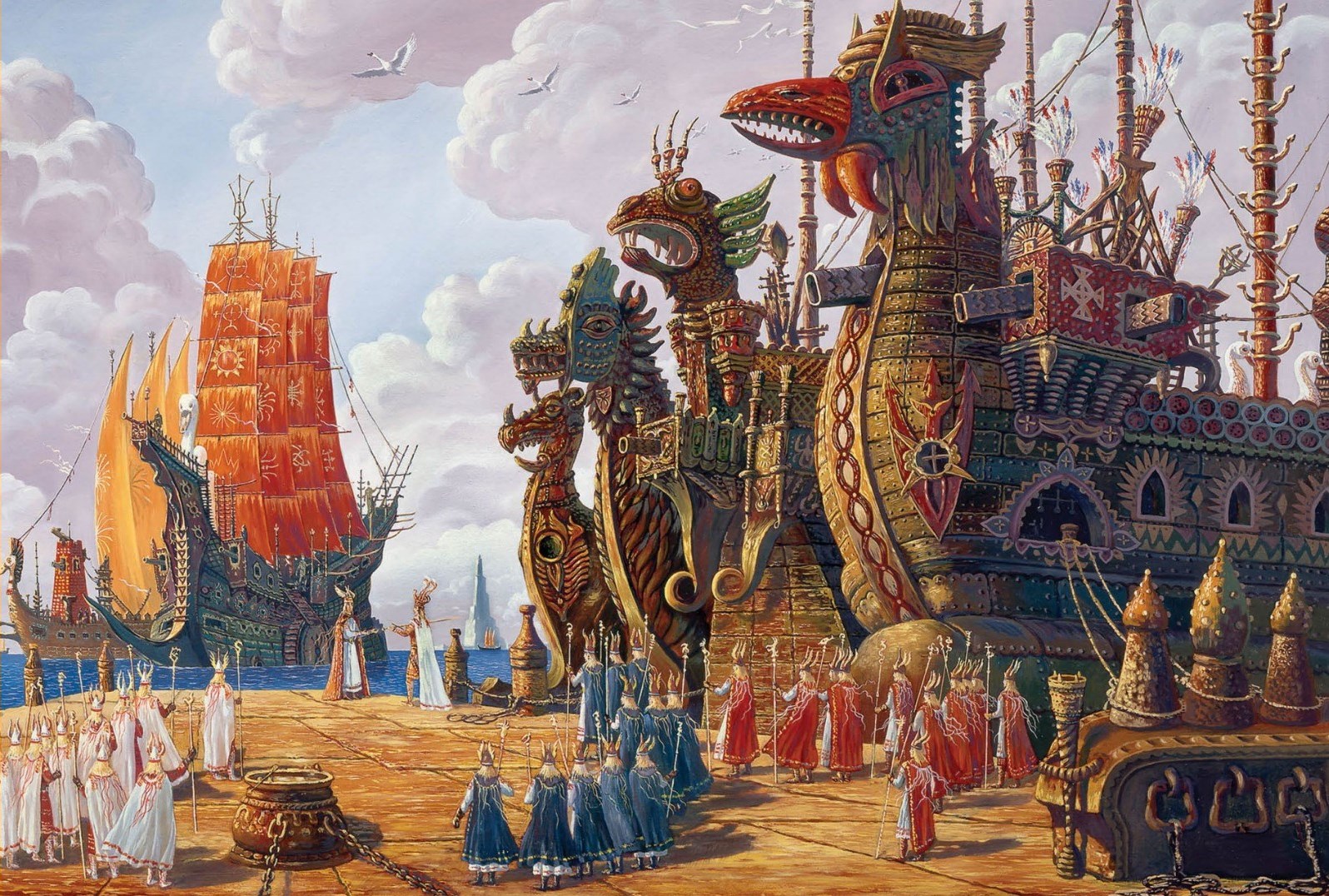
My inspiration was Tolkien (of course), his Númenórean race. The Ship is my creation, based maybe on some Greek or Roman designs. Done in photoshop, in some 35-40 hours. There is a lot of details which takes me ages to do.


Prompted by Sauron and fearing old age and death, Ar-Pharazôn built a great armada and set sail into the West to make war upon the Valar and seize the Undying Lands, and by so doing achieve immortality. Sauron remained behind. This force was quoted by Tolkien as the 'greatest force ever assembled on Arda'. In the year 3319 of the Second Age, Ar-Pharazôn landed on the shores of Aman. As the Valar were forbidden to take direct action against Men, Manwë, chief of the Valar, called upon Eru. The Undying Lands were removed from the world forever, and the formerly flat Earth was made into a globe. Númenor was overwhelmed in the cataclysm and sank beneath the sea, killing its inhabitants, including the body of Sauron who was thereby robbed of his ability to assume fair and charming forms, forever appearing in the form of a Dark Lord thereafter.


The Great Armament was the armada of warships and military forces prepared by the last King of Númenor, Ar-Pharazôn, for the purpose of invading the land of Aman to challenge the Lords of the West.


In S.A. 3261 Ar-Pharazôn invaded Middle-earth; by the following year Sauron submitted to him and was taken as prisoner to Númenor. Over the course of the next 48 years Sauron gradually seduced and corrupted the King and the majority of the Númenóreans. Feeling the coming of death, in S.A. 3310 Ar-Pharazôn initiated the construction of the Great Armament.


When preparation of the Armament became apparent, Amandil became dismayed and attempted to sail into the West to beseech the Valar for mercy and deliverance from Sauron. His mission failed and he was never heard from again.


For nine years Ar-Pharazôn amassed his strength in the havens of western Númenor while Elendil, Amandil's son gathered a small fleet of ships in the east that held the wives and children of the Faithful as well as their heirlooms and a store of goods. In secret the ship of Isildur, Elendil's son, also held a scion of Nimloth, the white tree.


As the Armament proceeded, omens appeared from the West – at first great clouds appeared in the shape of vast eagles, spreading darkness upon the land. As men hardened their hearts the clouds issued lightning that slew men, with one bolt smiting the dome of the Temple that Sauron had caused to be built in the city of Armenelos. Earthquakes shook Númenor and smoke poured from the summit of the Meneltarma, yet Ar-Pharazôn pushed all the more to complete his Armament.


Finally, in S.A. 3319, the King boarded his flagship Alcarondas and led the armada into the West. So vast was the Númenórean fleet that it surrounded all of Tol Eressëa. Coming upon the silent shores of Valinor, Ar-Pharazôn almost wavered but his pride won out - he landed and claimed the land for his own. Manwë then called upon Ilúvatar who put forth his power: The world was changed with a vast chasm rending the sea between Númenor and the Deathless Lands. The ships of the Great Armament were swallowed into the abyss while Ar-Pharazôn and his followers upon the shore were buried under falling hills.